
Use LTSpice to model decap and bondwire inductance is one of the best ways to understand how your circuits behave in real life. When designing electronic circuits, decoupling capacitors (decaps) and bondwires can affect performance more than we think. They introduce small resistances and inductances that can change voltage and current behavior, especially at high frequencies. By using LTSpice to model decap and bondwire inductance, you can simulate these effects before even building the circuit. This helps avoid mistakes, saves time, and reduces the cost of testing physical prototypes. In simple words, LTSpice acts like a “virtual lab” where you can test how your circuit reacts to tiny inductances and capacitances, making your design more accurate and reliable.
Using LTSpice to model decap and bondwire inductance allows designers to see problems that are not obvious with normal calculations. Bondwires, which connect a chip to its package, have small inductances that can cause voltage spikes or oscillations if not properly accounted for. Similarly, decoupling capacitors help smooth voltage, but their own inductance can reduce their effectiveness at high frequencies. By simulating these effects in LTSpice, engineers can test different values of capacitors, try various bondwire lengths, or adjust layouts to improve performance. Even beginners can follow simple LTSpice models to understand complex behaviors without deep math. With these simulations, you can avoid surprises when your circuit is built and ensure stable, reliable performance in real-world applications.
Table of Contents
Use LTSpice to Model Decap and Bondwire Inductance
Use LTSpice to model decap and bondwire inductance is an essential skill for anyone designing electronic circuits. These small elements—decoupling capacitors (decaps) and bondwires—might seem tiny, but they can cause big effects on your circuit’s performance. LTSpice helps you simulate these effects before building the circuit, saving time, money, and frustration. In this article, we will explain everything you need to know, step by step, in easy English.
What is Decap and Bondwire Inductance?
Before we use LTSpice to model decap and bondwire inductance, it’s important to understand what they are. A decoupling capacitor is used in circuits to stabilize voltage and remove noise. Bondwires connect the chip inside a package to the pins, but they are not perfect. Bondwires have tiny inductances, which can cause voltage spikes or oscillations at high frequencies. Even small inductances in decaps or bondwires can affect how a circuit works, especially in fast digital or RF circuits. Modeling these elements helps designers prevent unexpected behavior in their designs.
Why Use LTSpice for Modeling?
LTSpice is a free and powerful simulation tool for electronic circuits. Using LTSpice to model decap and bondwire inductance lets you test your design in a “virtual lab.” You can see how different capacitor values, bondwire lengths, or layouts affect your circuit without building it physically. This is useful for beginners and professionals alike because it allows quick testing, comparison, and adjustment. By simulating your circuit, you can detect potential problems like voltage dips, ringing, or instability before they happen in real life.
Step-by-Step Guide to Use LTSpice to Model Decap and Bondwire Inductance
1. Set Up Your Circuit
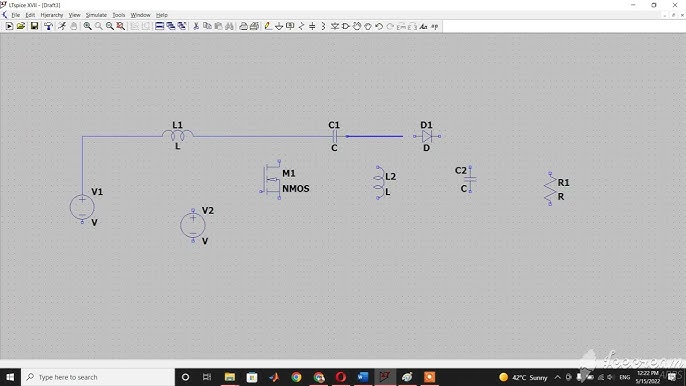
Open LTSpice and create a new schematic. Place the components like resistors, capacitors, and voltage sources that match your real circuit. Include the decap and bondwire elements in your design.
2. Add Bondwire Inductance
Bondwire inductance is usually small, around 1–5 nH per millimeter. In LTSpice, you can model it as a small inductor in series with the connection between your IC and the capacitor. Make sure the values match your real bondwire lengths to get accurate results.
3. Model Decap Inductance
Decoupling capacitors also have inductance called Equivalent Series Inductance (ESL). Add a small inductor in series with the capacitor in your LTSpice model. This helps you see how the capacitor performs at high frequencies, not just DC.
4. Run the Simulation
Set the simulation type. For high-frequency effects, use AC analysis or transient analysis. Observe voltage spikes, current flow, and ringing caused by inductances.
5. Analyze the Results
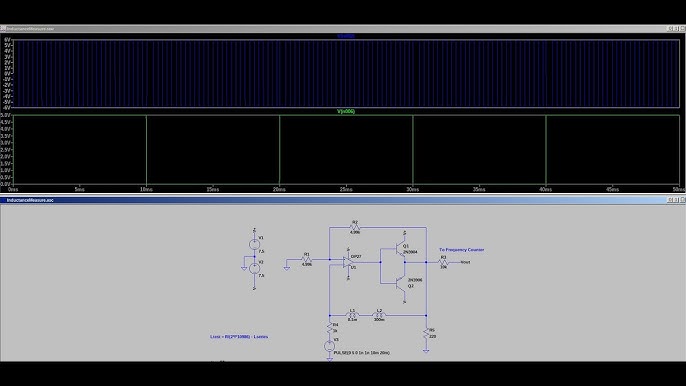
Look at the graphs generated by LTSpice. Check if the bondwire inductance or decap ESL is causing voltage overshoot or unstable behavior. Adjust capacitor values or bondwire lengths in your model and simulate again to optimize your circuit.
Tips to Use LTSpice to Model Decap and Bondwire Inductance
- Keep it simple: Start with basic models and gradually add complexity.
- Use real values: Always use real component values for accurate simulation.
- Check high-frequency behavior: Some effects only appear at high frequencies, so run AC analysis.
- Compare scenarios: Try different capacitor types or bondwire lengths to see the best configuration.
Common Mistakes to Avoid
- Ignoring bondwire inductance: Even a tiny inductor can affect fast circuits.
- Assuming capacitors are ideal: Real capacitors have ESL that can change performance.
- Skipping AC analysis: Transient analysis alone may not show high-frequency problems.
- Not adjusting values after simulation: Simulations should guide design changes.
Real-Life Example
Imagine a microcontroller circuit with a 100 nF decap on the power line. The bondwire to the IC is 2 mm long with 2 nH inductance. If you ignore the bondwire inductance, the circuit might show voltage dips at fast switching times. Using LTSpice to model the 2 nH bondwire and the decap’s 0.5 nH ESL, you can simulate the voltage spikes. Then, you may increase the capacitor value or add another decap to reduce the spikes. This saves you from building multiple prototype boards.
How LTSpice Saves Time and Money
By using LTSpice to model decap and bondwire inductance, you can test different designs virtually. This reduces the number of physical prototypes needed, avoids costly mistakes, and speeds up the development process. It also allows better planning for PCB layout, component selection, and high-frequency performance. Engineers can share LTSpice files with team members, making collaboration easier and more precise.
Advanced Tips
- Use sub-circuit models: Some capacitors come with manufacturer SPICE models that include ESL and ESR.
- Try parametric sweeps: Test different bondwire lengths or capacitor values automatically.
- Include PCB traces: Add small inductances for traces to simulate real-world effects more accurately.
Conclusion
Using LTSpice to model decap and bondwire inductance is a powerful way to make your circuits more reliable and efficient. It helps engineers understand high-frequency effects, choose the right components, and optimize designs before building anything. Even beginners can quickly learn how to model these small but important elements and avoid common pitfalls. Simulating your design saves time, money, and headaches while ensuring stable and accurate circuit performance.
FAQs
Q1: Can beginners use LTSpice to model decap and bondwire inductance?
Yes, LTSpice is beginner-friendly. Start with simple circuits and small inductance values to understand how decaps and bondwires affect performance.
Q2: What is the typical inductance of a bondwire?
Bondwire inductance is usually between 1 nH and 5 nH per millimeter, depending on wire thickness and material.
Q3: Do all capacitors have inductance?
Yes, all real capacitors have Equivalent Series Inductance (ESL), which affects high-frequency behavior.
Q4: Why is modeling important instead of just calculating?
Calculations often ignore parasitic elements like bondwire inductance and ESL. Simulation with LTSpice shows real-world behavior more accurately.
Q5: Can LTSpice simulate PCB traces too?
Yes, you can add small inductors in series with traces to approximate PCB trace effects, improving simulation accuracy.